When Illegal Operators Look Legitimate: The Digital Challenge Facing Africa’s Gaming Industry
The gambling industry has always evolved alongside technology. From traditional betting environments to online platforms, mobile applications, digital payments, livestreaming, and algorithm-driven advertising, technological advancement has consistently shaped how the industry operates and expands.
In Africa, this relationship between gaming and technology has become even more pronounced. As one of the most mobile-first continents in the world, digital accessibility has accelerated the visibility and growth of online gaming at an unprecedented pace. Smartphones, social media platforms, and instant payment systems have made participation more accessible, more immediate, and more integrated into everyday digital life.
This rapid digital expansion has positioned Africa within a unique moment of opportunity. A young population, increasing internet penetration, and growing technological adoption continue to create fertile ground for the industry’s development across the continent.
At the same time, this digital evolution has introduced a challenge that is becoming increasingly difficult to ignore.
The Legitimacy Problem in Digital Spaces
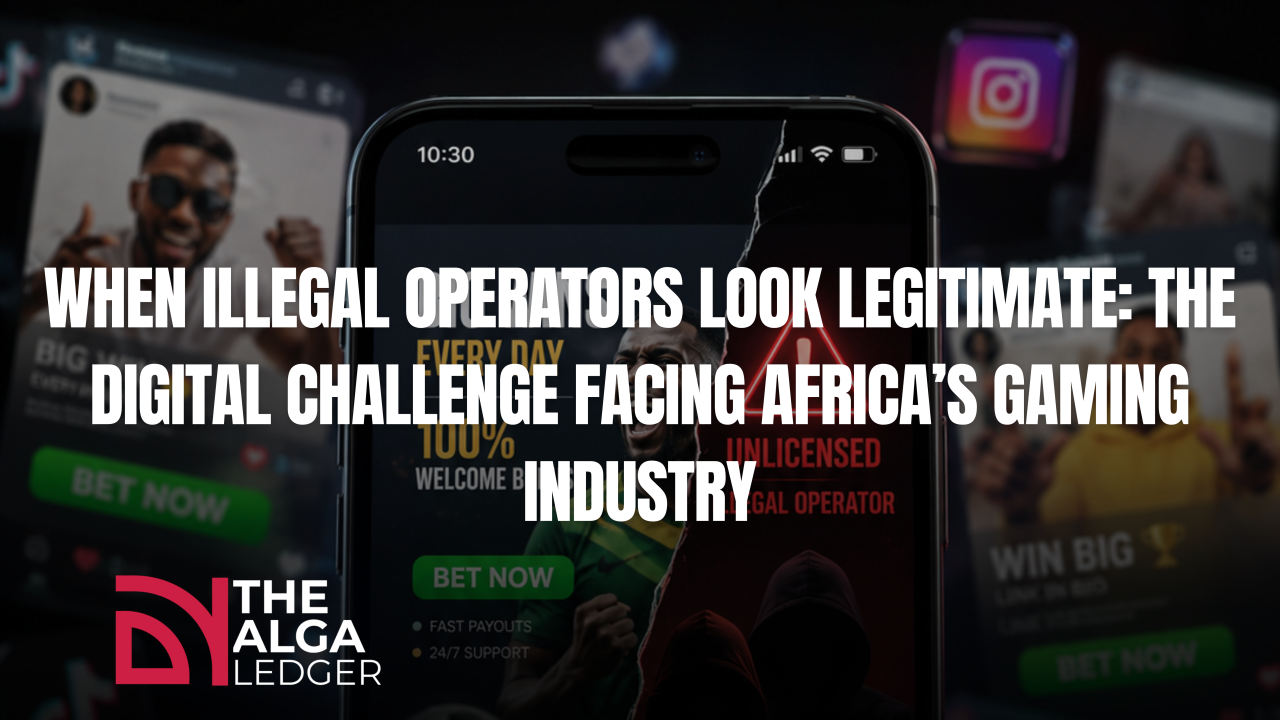
Illegal operators no longer present themselves in obviously suspicious ways.
Many now operate with sophisticated branding, professionally designed websites, influencer collaborations, sports affiliations, and highly targeted social media advertising. To the average consumer scrolling through a timeline or watching sports content online, there is often little visible distinction between a licensed operator and an illegal one.
This is where the complexity of the modern digital environment emerges.
Social media has become one of the most influential distribution channels for gaming visibility. Gambling advertisements appear alongside mainstream entertainment, sporting content, lifestyle influencers, and trusted public figures. Visibility within these environments can easily be interpreted as credibility.
Consumers are already aware of scams, misinformation, and fake profiles online. Social media platforms constantly encourage users to remain cautious in digital spaces. However, gambling advertisements occupy a far more nuanced position because many illegal operators no longer look untrustworthy on the surface.
In many cases, they look legitimate.
Why This Matters for the Industry
The concern surrounding illegal operators extends beyond regulation alone.
When consumers struggle to distinguish between compliant and non-compliant platforms, trust within the broader ecosystem begins to weaken. Illegal operators can damage public confidence, expose users to financial and security risks, and undermine the credibility of regulated businesses operating responsibly within legal frameworks.
As Africa’s gaming industry continues to mature, trust will become one of its most valuable assets. Growth without trust creates instability. Visibility without accountability creates vulnerability.
The long-term sustainability of the industry will depend not only on expansion, but on the ability to create environments where consumers can participate confidently and safely.
This is particularly important within African markets where digital adoption is advancing rapidly and younger audiences are increasingly exposed to gaming-related content through mobile-first platforms.
The Importance of Verification and Consumer Awareness
As digital gambling visibility increases, consumer education and verification mechanisms become increasingly important.
This is why initiatives such as the National Gambling Board South Africa 's verification platform represent an important development for the industry. Providing consumers with a tool to verify licensed operators introduces a practical layer of transparency within highly saturated online environments.
It shifts the conversation from simple awareness to informed participation.
Verification systems not only help protect consumers, but also reinforce the credibility of compliant operators that are investing in responsible and regulated growth. In a digital ecosystem where visibility can easily be mistaken for legitimacy, access to clear and reliable verification becomes essential.
This is no longer only a regulatory conversation. It is also becoming a digital literacy conversation.
Building a More Responsible Digital Ecosystem
Africa’s gaming industry is entering a defining era. The opportunity surrounding the sector is substantial, and global attention toward African markets continues to increase.
However, the next phase of growth will require more than innovation and accessibility alone. It will require stronger collaboration between regulators, operators, technology platforms, payment providers, industry bodies, and media stakeholders to ensure that digital gaming environments remain transparent and trustworthy.
The conversation around responsible gaming must now evolve alongside technology itself. As advertising becomes more sophisticated and social media continues to shape consumer behaviour at scale, the industry must also strengthen the systems that protect users within these spaces.
The future of Africa’s gaming industry will not be defined solely by how quickly it grows, but by how responsibly it grows.
Because in today’s digital landscape, the greatest challenge is not always identifying what is fake.
It is recognising what only appears legitimate.